

All Projects

01. Outcome
02. Current Playlist Audit

(The current social function named collaborative playlist, which can be found from Your Library)
The current collaborative playlist Analysis:
- Mostly serving for close friends
- Use it for online remote listening mostly
- Did not offer enough connection/interaction feature for strangers
- Not perfectly serving for real-word co-listening
05. User Journey

06. User Painpoints
Missing Process
- Though the app provides the room for collaborating by allowing users to create collaborative playlists and invite other people to edit them together. But these relevant features are not coherently designed, considering many users are not aware that they can use these features for group music listening.
Unmet Needs
- Party-goers are not easily aware that there is a feature for group music listening.
- Pary-goers do not know how to have more interaction and open up the conversation with other party-goers utilizing the collaborative playlist
07. Solutions
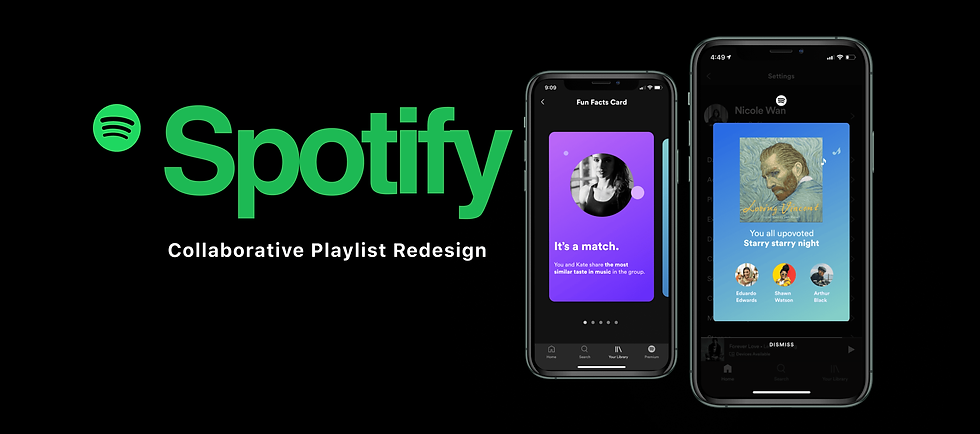
Feature 1. Create a social mode in the collaborative playlist.
Feature 2. Under the social mode, Set up an upvote function that can allow guests in the party to do an interaction through voting.
Feature 3. Under the social mode, design the music contributors section & Fun facts for collecting gust’s music interests, gusts can browse the people who have similar music tastes with them and follow the people or facilitate them having a conversation.
Feature 4. Put Spotify advertising into the music recommendation.
For solving stranger socialization issues in public events or parties, I decided to create Feature 1. Considering saving unnecessary costs in developing, we decided to set up feature 1 in the current collaborative playlist. For improving the interaction between strangers in the real-world co-listening scenario, we decided to add upvote and music contributors functions in the social mode. Put Spotify ad to enhance the business profits.
08. User Flow
Based on our research and understanding of Spotify, we decide to respect the current app structure and the common playlist layer and add the party playlist feature as a different mode for the existing playlist.

10. Wireframe
Before the Party

During the Party

After the Party

11. Hi-Fi Flow
We created a hi-fi design screen based on the design exploration and iteration: each flow and features address the pain points, or unmet user needs we identified in the user research. The final design draft includes three different states of experience.
Before the party


12. Usability Testing
The team conducted usability testing to see if the final design does communicate well with the users.
5 users were tested in total with the final version interface. I asked follow-up questions.
Based on the feedback, the team came up with several explorations to backup the current design limits.

Duration
Spring 2020 (4 months)
Team
Moe, Olivia
My Role
Product Designer
Background
Spotify APP Redesign is a project that tried to solve the music social issues under the scenario like public events or parties by improving its current collaborative playlist. My role was to research, design, and test usability for the project. I collaborated with other 3 UXUI designers to finish this project.

09. Sketch
11. LEARNING RECAP

Overview
Confirm the assumption
The insight we got from the user survey is that people think music is an excellent way to make strangers closer.
Based on this insight, we came up with the idea, "Social music listening should also include the real-world co-listening scenario when people are actually around each other."
03. User Research
04. Party Scenario

13. Feature Exploration